 jessica@honch-etech.com
 English

 Item(s)

Who benefits from an AI cabinet devouring 440000 MLCCs?
The recovering MLCC market has once again been ignited by AI.
Global leader in passive components, Murata, pointed out that AI "eats" MLCCs in astonishing quantities: one Nvidia GB300 server requires about 30000 MLCCs, and the usage of a single cabinet can even reach up to 440000.
More importantly, this demand is still surging upwards. It is expected that by 2030, the demand for MLCC from AI servers will increase by about 3.3 times compared to 2025. In this context, Murata has raised its revenue forecast for the fiscal year 2025.On the other hand, Samsung Motors is also increasing its investment. The company plans to expand the production capacity of MLCC for AI servers from early 2026 and is optimistic about the demand performance of high-end MLCC this year.
At the same time, several passive component manufacturers have also reported good news for the AI application market
So, why do AI servers use such a large number of MLCCs? How much is their increment? Which passive component manufacturers will benefit from this?
1.How much MLCC does an AI server need to consume?
ECIA data shows that the global passive component market will reach approximately 34.6 billion US dollars in 2022, with capacitors, inductors, and resistors being the three major players in passive components (accounting for approximately 89% of the total). The capacitor market will account for 65%, the highest proportion.
In the capacitor market, MLCC (multi-layer ceramic capacitor) is the product with the highest proportion, commonly known as "industrial rice" in the industry.
According to ECIA data, network communication, automotive, power, and industrial control are the main downstream applications of passive components, with network communication, automotive, power, and industrial control accounting for 42%, 16%, and 10%, respectively.
The emerging fields of network communication, such as AI servers and data centers, have further pushed the usage of MLCC to the "10000 level era".
In the entire AI application, the usage ranking of MLCC is usually: AI server>communication device>edge AI (industrial gateway, camera)>AI PC/AI phone.
An AI phone only requires about 1000-1500 MLCCs, an AI PC requires between 1800-2500, and an AI server requires tens of thousands of MLCCs. Murata stated that the 30000 MLCCs used in GB300 are about thirty times that of a mobile phone and three times that of a vehicle.
According to securities institutions' calculations, the number of GPUs in a single cabinet of AI servers has jumped from 8 in HGX H100 to 576 in RUBIN ULTRA NVL576, an increase of 72 times. With the synchronous increase in the number of GPUs and HBMs, the usage of passive components is exponentially increasing. The usage of single cabinet MLCC (low standard) is expected to grow from about 48000 HGX H100 in 2022 to about 4.3 million RUBIN ULTRA NVL576 in 2027, an increase of nearly 90 times.

If an electronic device is compared to a city, then the power supply is like the city's water supply network, while MLCC is like countless small pools and buffer tanks scattered throughout. Its main functions include:
● Decoupling (making the power supply cleaner)
● Filtering (suppressing noise and ripple)
● Energy storage (providing instantaneous power supply)
The performance bottleneck of AI servers lies in computing power, but the design difficulties often lie in power supply and cooling.
In the power supply system, MLCC is the absolute protagonist. In high power consumption and high transient load scenarios such as AI servers, MLCC failure or improper selection is often not a "bad one" problem, but directly affects GPU stability and system verification progress.
Therefore, AI servers have much higher requirements for power stability than mobile phones or home appliances. AI servers require MLCCs with larger quantities, smaller sizes, larger capacities, and higher reliability.
MLCC has risen to become one of the top three cost components in AI server BOM.
Data shows that NVL36 and NVL72 require approximately 234000 and 441000 high-level MLCCs, respectively, which is 10-21 times the usage of typical AI servers, driving the value of MLCCs to $2500-4600 per machine.
According to Mordor Intelligence, the global MLCC market is expected to reach $27.25 billion by 2025 and climb to $61.12 billion by 2030, with a compound annual growth rate of 17.53% over the forecast period. Strong demand is expected from electric vehicles, 5G infrastructure, and AI servers.
In addition to MLCC, resistors, inductors, and other capacitors (such as polymer tantalum/aluminum electrolysis/thin film) account for a smaller proportion in the number of AI servers, but they are equally crucial for the stable power supply, signal/power integrity, EMI suppression, and reliable operation of AI servers.
2.Which major companies are benefiting?
The multi-layer ceramic capacitor (MLCC) market is highly controlled by a few giants, with Murata, Samsung Electric, and Taiyo jointly controlling the majority of global production capacity and having strong pricing power in high-end specialty products.
The reason why they are difficult for newcomers to surpass is that they have mastered the core technologies that determine the performance and reliability of MLCC - ceramic powder, multi-layer printing process, and terminal slurry formula - in their own hands, forming their own moat and setting a high entry threshold for newcomers.
The rise of AI servers has pushed demand towards the top few companies that already possess high-end capabilities, which are the technological highlands that top manufacturers have long been deeply cultivating and that newcomers find difficult to catch up with.
The TrendForce 2024 research report shows that the upgrade of AI servers and laptops is driving the demand for high-capacity MLCC, with up to 80% of high-capacity MLCC usage. Korean and Japanese MLCC suppliers who control most high-capacity products will become the main beneficiaries.
In high computing power and high power consumption scenarios, the requirements of AI servers for MLCC are mainly reflected in the following points:
The proportion of MLCCs with higher capacitance values (above 1 µ F) has significantly increased;
The usage of MLCC with high temperature resistant medium type (such as X7S/X7R) is higher;
Emphasize low ESR/low ESL performance (affecting GPU/accelerator card stability), that is, fast transient response speed of the power supply;
The demand for small-sized, high-capacity MLCCs such as 0402/0201 has increased.
TrendForce also stated that taking the GB200 system motherboard of AI servers as an example, MLCC usage above 1uF accounts for 60%, X6S/X7S/X7R (MLCC temperature characteristics) high temperature resistance usage is as high as 85%, and the total price of MLCC on system motherboards has doubled.
From the specific parameters, taking Murata's announced mass production of 0402 inch (1.0mm × 0.5mm) MLCC (GRM158C80E476ME01/GRM158R60E476ME01) with a capacity of up to 47 µ F in July 2025 as an example, this was the earliest miniaturized MLCC with a capacity of up to 105 ° C in the industry at that time. It can be placed near chips and is particularly suitable for high-performance IT equipment such as data centers (including AI servers), as well as various civilian devices.
According to iM Securities, Murata (45%) holds the largest market share in the global AI server MLCC market, followed by Samsung Electric (39%). Currently, the two companies dominate the global AI server MLCC market.
Murata: Strong demand for AI servers
Murata has raised its full year business forecast in its recently released financial report, expecting steady growth in revenue and profit for the fiscal year 2025 (ending in March 2026). Revenue expectations have increased from 1.64 trillion yen to 1.74 trillion yen, and operating profit has increased from 220 billion yen to 280 billion yen, mainly driven by strong demand in the AI server and peripheral smart device markets. The company has also raised the expected compound annual growth rate of MLCC for AI servers from about 18% to about 30%, and it is expected that the related demand scale will exceed three times that of 2025 by 2030.
Murata's current business is mainly divided into two major segments: component business (accounting for about 63%) and device and module business (accounting for about 37%). Among them, capacitor products (including MLCC) belong to the component business, accounting for up to 50%.
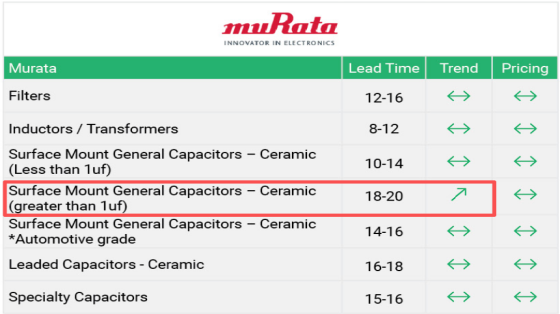
According to Fuchang's Q4 2025 market report, the lead time for Murata's universal ceramic capacitors (1 µ F or above) is 18-20 weeks, with a trend of extension. However, this category has a wide coverage, and the high-end specification models that are truly used for AI servers have higher pressure resistance and reliability requirements.
Samsung Electric: will expand AI server MLCC production capacity
The latest Q3 2025 financial report released by Samsung Electric shows that the company achieved revenue of approximately 2.889 trillion Korean won and operating profit of approximately 260.3 billion Korean won, both of which showed year-on-year growth. This was mainly driven by the increasing demand for high-end solutions in AI, automotive, and server applications. The company expanded its supply of industrial and automotive multi-level integrated control (MLCC) and server FCBGA.
Samsung Electric has previously stated that the company is shifting its business focus from standard IT consumer electronics products to high value-added products such as AI servers, and the related capacity utilization rate is also close to full load. The demand outlook for 2026 is optimistic. Samsung Electric has planned to expand its MLCC production capacity for AI servers starting from early 2026.
In addition to the top two companies Murata and Samsung Electric, other Japanese and Korean manufacturers have also deployed MLCC for AI servers.
Taiyo has launched multiple new MLCCs designed for AI server power decoupling in 2025 and started mass production; TDK has also explicitly proposed an MLCC solution for data center power supply in the AI era in its official technical documentation.
Overall, the most core and highest specification MLCC in AI servers is still mainly dominated by Japanese and Korean manufacturers.
The beneficiaries of AI server are also Taiwan, China manufacturers Yageo and Walsin, whose passive component products applied to AI server are benefiting from the explosion of AI demand.
Yageo: Strong demand for AI and advanced application products
Yageo is the world's largest manufacturer of R-Chip chips, tantalum capacitors, as well as the third-largest manufacturer of MLCC and inductors.
Yageo Chairman Chen Taiming stated in early 2025 that the group has control over all passive component product lines required for AI. Among non foreign manufacturers, it is the largest supplier of X6S MLCC models for AI servers and has entered the Nvidia supply chain through contract factories. In addition, last year, Yageo's subsidiary kemet issued two price increase letters for tantalum capacitors, which included many AI server application products.
Yageo's revenue in 2025 reached NT $132.93 billion, a year-on-year increase of 9.3%, setting a new historical high. Benefiting from the strong demand for AI and advanced application products, Yageo's AI related revenue accounts for about 10-12%. It is expected that AI demand will continue to be strong in 2026, driving the shipment of advanced components and improving the product portfolio. Niche products will benefit from the momentum of AI applications, with a capacity utilization rate of over 80%.
Walsin: AI related products help increase gross profit margin
Walsin Cobb Bureau tantalum capacitors (mainly from Matsuo Electric in Japan), inductors, related magnetic components, and general MLCC fields.
Walsin Technology recently stated that AI related revenue currently accounts for about 10%. AI related applications are mainly supplied to EMS factories and power supply factories, including X6S MLCC, special resistors, medium and high voltage, safety capacitors, and are classified into industrial and AI server power supplies.
AI related products will also drive a significant increase in specifications, which will help improve gross profit margins. The company is currently actively designing new products and improving specifications to enhance ASP. With the continuous shipment of new products and specifications, it will help to improve operations in 2026.
Related Information




- 1500+ Daily average RFQ Volume

- 20,000.000 Standard Product Unit

- 1800+ Worldwide Manufacturers

- 15,000+ In-stock Warehouse


