 jessica@honch-etech.com
 English

 Item(s)

MLCC, Being robbed crazily!
According to supply chain sources, the market supply is structurally tight rather than experiencing widespread shortages. The demand for high-capacity, high voltage, and high reliability MLCCs for artificial intelligence servers, high-performance computing, and 800V electric vehicle platforms has exceeded expectations, resulting in delivery cycles for some models extending from a few weeks to over 20 weeks or even longer.
A passive component distributor stated that customers are shifting their focus from price to supply safety, and production stoppage has become a greater risk. According to supply chain sources, the procurement team is prioritizing inventory buffering and source stability, while Murata Manufacturing and some major Taiwanese suppliers have tightened orders and shipments for high-end multilayer ceramic capacitors (MLCC).
The construction of artificial intelligence data centers and the increasing demand for high-end MLCC from electric vehicles are accelerating, forcing downstream customers to seek second or even third suppliers. Sources say that Chinese manufacturers who have expanded their high-end MLCC business in recent years are expected to benefit from this shift.
Analysts say that the "order lock" mentioned in the report does not mean that suppliers have stopped accepting orders. Manufacturers are actually prioritizing meeting long-term customer and contract needs, especially in the supply chain of artificial intelligence servers. Long term agreements enable cloud service providers and artificial intelligence platform customers to lock in high-end MLCC production capacity in advance.
The continuous increase in GPU power consumption has made AI servers more reliant on MLCC for voltage regulation and filtering. Market research shows that the number of MLCCs required for AI server platforms is several times that of traditional servers, which has driven the demand for high-end MLCC products to grow exponentially.
The 2018 passive component shortage event remains a cautionary reference point. At that time, channel overbooking and inventory backlog led to a surge in prices, followed by a rapid decline and severe inventory adjustments. This time, manufacturers are more cautious, controlling shipment speed, verifying actual demand, and limiting spot market transactions to reduce the risk of price overheating.
The MLCC market is becoming increasingly segmented. The general MLCC for consumer electronics products is gradually returning to balance after inventory adjustment, while the high-end MLCC market for artificial intelligence servers, data centers, automotive electronics, and industrial applications is still in short supply.
Market analysts say that artificial intelligence and electric vehicles are reshaping the global demand pattern for MLCCs (multi-layer ceramic capacitors), reducing the industry's reliance on smartphones and personal computers as the main growth engines. Artificial intelligence infrastructure and automotive electronics are driving the next wave of demand. Due to the advanced material formulation, ultra-thin dielectric layer processing, and precision stacking technology required for high-end MLCC, short-term capacity expansion is unlikely to quickly fill the gap. It is expected that the tight supply situation will continue for one to two years.
For Taiwan's supply chain, this cycle is beneficial for suppliers such as yageo and walsin Technology, while also exposing the problem of passive component order overflow. Due to the still tight supply of high-end components, some demand is shifting towards China's MLCC supply chain.
The rapid development of artificial intelligence is driving a shift in the delivery of key components, particularly MLCC ceramic capacitors, as well as a $1.5 billion alternative silicon capacitor transaction.
Due to the higher voltage of 48V power lines compared to 12V systems, which can reduce power loss and improve circuit board design efficiency, the application of 48V power lines is accelerating. At the same time, resonant circuits such as resonant converters (LLC) are increasingly being used for efficient power conversion. The launch of the new 800V power system marks a new stage in the AI server power architecture, and AI power systems are becoming increasingly complex and precise.
This is driving the transformation of a key passive component - multilayer ceramic capacitors (MLCC). The production of MLCC is mainly led by Japanese companies, including Murata Manufacturing Co., Ltd TDK\ Kyocera AVX and Taiyo electricity, as well as Samsung Electric in South Korea and Guoju in Taiwan, China.
Samsung stated that the wave of artificial intelligence is shifting from semiconductors to passive component MLCC. The number of MLCCs used by artificial intelligence servers is 10 to 15 times that of general-purpose servers. They not only drive market demand, but also put forward higher requirements for ultra-high capacitance and high-voltage MLCC, which require advanced technology.
Therefore, major suppliers in Japan and South Korea have shifted their production capacity to components for artificial intelligence applications. This in turn leads to seasonal limitations on the supply flexibility of consumer grade MLCC.
Market analysts and distributors have warned that high-capacity MLCCs are entering a shortage period as first tier manufacturers shift their production lines to support rapid expansion of artificial intelligence infrastructure.
This situation reminds us of 2021, when the supply of MLCC became a key problem for equipment manufacturers due to the shortage caused by the COVID-19 epidemic.
According to the latest market research by Taiwan TrendForce, the MLCC market will show significant differentiation in the second quarter of 2026, with strong AI driven demand on one hand and weak consumer demand on the other. The Iran conflict has pushed up oil and gas prices, resulting in rising energy and transportation costs, while inflation is expected to intensify and put pressure on end market demand and corporate capital expenditures.
These impacts are gradually affecting the electronic component supply chain. At the same time, the prices of key metals such as silver, aluminum, and copper have risen, resulting in an average increase of 10% to 15% in passive component prices.
The tight supply of key components has prompted original equipment manufacturers such as Dell and HP to take strategic inventory building measures. Some mid to low end laptop orders originally scheduled for production in the third quarter have been advanced to the second quarter for production and shipment, in order to lock in lower price expectations, stimulate demand, and increase revenue.
As the production capacity of consumer grade MLCC continues to decline and the inventory control becomes more and more strict, agents in Taiwan and Chinese Mainland have begun to reserve X5R standard products in advance (capacitance values between 1000pF and 10 µ F).
In April 2026, Taiyo was the first to raise the prices of low capacity consumer electronics and automotive MLCCs by 6% to 13%. By early May, some equipment manufacturers had completed price negotiations with MLCC suppliers for the third quarter of 2026, and the market was recovering. As most ODM manufacturers begin a new round of price negotiations in late May, a key question is whether the current market conditions will drive a rebound in MLCC prices for automotive and consumer electronics applications.
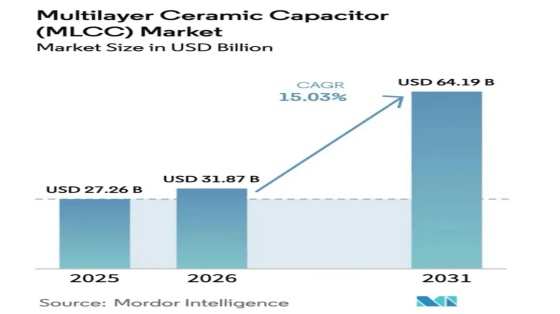
Mordor Intelligence estimates that the market size of low-voltage MLCC will be 6.17 billion US dollars in 2025, expected to grow from 18.97 billion US dollars in 2026 to 42.18 billion US dollars in 2031, with a compound annual growth rate of 17.33% for passive components.
The demand for 5G smartphones, artificial intelligence servers, and electric vehicles requires the use of ultra compact, low loss capacitors that can be installed in increasingly small spaces while providing higher unit volume capacitance. Although the Asia Pacific region still maintains a leading position in manufacturing and consumption, nearshore outsourcing and semiconductor stimulus plans are driving new production capacity closer to end customers in North America.
Leading manufacturers are expanding the production of multilayer ceramic capacitors (MLCCs) with a thickness of less than 0.3 microns to further reduce the size of MLCCs without sacrificing reliability. At the same time, the price fluctuations of nickel and palladium make cost forecasting more complex, prompting people to actively carry out recycling plans and material innovation.
This demand has been reflected in the recent shipment volume and revenue performance of contract equipment manufacturers such as Guangda, Wistron, and Compal. However, TrendForce points out that due to OEM manufacturers not yet raising their full year shipment expectations, there may be risks of weaker than previous years during the peak season in the second half of the year, and orders may also be adjusted.
Taiyo has raised the prices of low to medium capacity consumer grade MLCCs and some automotive products sold by Chinese distributors by approximately 6% to 13%. At the same time, leading suppliers in Taiwan are conducting individual negotiations on price adjustments for certain loss making products, but have not yet announced a comprehensive price increase. Industry leaders Murata Manufacturing and Samsung Electric have not officially announced price increases, but overall price expectations are shifting from cautious observation to exploratory price increases.
TrendForce expects that by the end of the year, artificial intelligence server projects will increase demand for high-end MLCC, thereby driving up prices.
However, inventory adjustments in the personal computer and laptop markets, as well as geopolitical uncertainties and changes in monetary policy, will still be key risks affecting consumer MLCC demand and pricing.
This imbalance stems from the surge in deployment of artificial intelligence servers, which require a higher proportion of dedicated passive components compared to standard enterprise grade hardware. Evertiq's analysis indicates that Murata Manufacturing and Taiyo are prioritizing the provision of high-performance and high reliability components for data centers. This redistribution of production capacity has resulted in extended delivery cycles for high-capacity components in the 1206 and 1210 package sizes typically used in the power management phase.
Although standard 0402 and 0603 MLCC capacitors are still in sufficient supply, the delivery cycle for large-sized devices has exceeded 20 weeks. This unstable supply makes production plans in the industrial automation and medical electronics industries complex, as redesigning PCBs to accommodate different capacitor packaging is both time-consuming and costly.
Market analysis indicates that this shortage is not caused by a shortage of raw materials, but rather a deliberate strategy adopted by manufacturers to maximize profits.
Evertiq stated, "Despite clear signs of recovery, suppliers are still unwilling to increase new production capacity for low margin components." This cautious capital expenditure strategy means that any sudden surge in demand for consumer electronics or industrial electronics could lead to widespread shortages on the entire material list.
Distributors' inventory can provide a temporary buffer, but as first tier OEM manufacturers consume existing inventory, smaller manufacturers will face increasingly fierce competition for remaining quotas. The procurement strategy is shifting from an immediate supply model to long-term agreements for key passive components to ensure production continues until 2026.
The difference between the demand driven by artificial intelligence and the overall industrial recovery is creating a dangerous procurement gap for standard hardware manufacturers. Enterprises must now ensure access to high-capacity MLCC quotas, as delivery times may be further extended when automotive demand matches current server construction needs. "
This is not surprising. As early as March this year, Murata Manufacturing opened its latest multi-layer ceramic capacitor (MLCC) factory in Izumo, Japan. This factory, which cost 255 million euros, began construction in 2024 and has a production area of 70000 square meters. This move aims to help Murata Productions cope with the medium to long term MLCC demand growth brought about by the continuous expansion of the Japanese and Chinese markets.
The company stated, "By distributing MLCC production bases in Japan, ASEAN, and China, and expanding production capacity in a balanced manner, we are striving to establish a system that can flexibly respond to changes in market environment and growing demand. "
In order to support GPU and CPU to consume thousands of amperes of current at low voltage of 0.8V, the demand for high capacitance MLCCs is increasing day by day. The total capacitance of MLCC must be increased to ensure stable power supply for GPU power dynamic changes.
Nvidia's Grace Blackwell GB200 server motherboard requires approximately 6500 MLCCs (multi-layer ceramic capacitors), and the upcoming Rubin architecture will increase the number of MLCCs per motherboard to around 12000. At the same time, Microsoft AWS\ Cloud service providers (CSPs) such as Google and Meta are steadily increasing orders for self-developed ASIC chips and CoWoS advanced packaging technology, thereby driving up long-term demand for high-end MLCCs.
The MLCC (multi-layer ceramic capacitor) located near the high-performance computing board GPU and CPU plays a decoupling role to alleviate rapid changes in current. With the improvement of chip performance, the installation area decreases while the required capacitance value increases. This requires the use of capacitors exceeding 47 µ F in the 0402 size package, or capacitors exceeding 10 µ F in the 0603 size package.
The use of surface mount technology and MLCC capacitors close to GPU solder balls are also increasing. The embedded MLCC and the pad side MLCC installed inside or directly below the semiconductor package significantly reduce loop inductance while increasing capacitance density. The power density per unit area is related to the capacitance density, and Samsung is actively evaluating X7T 0402 size 22 µ F and X6S 47 µ F 2.5V MLCC.
Another factor is power efficiency. Although a 48V system requires a 100V MLCC, a 120kW power transmission system for converting AC to 800V requires a larger capacity of 1kV-2kV MLCC.
To cope with the dynamic changes in GPU load current, a larger core power supply current is required. VPD (Vertical Power Supply) technology is a power module that not only shortens the power supply path as much as possible, but also increases power density.
Related Information




- 1500+ Daily average RFQ Volume

- 20,000.000 Standard Product Unit

- 1800+ Worldwide Manufacturers

- 15,000+ In-stock Warehouse


