 jessica@honch-etech.com
 English

 Item(s)

The price increase of chips is too fierce, and the aftermath is coming
It is expected that memory chip prices will continue to rise, pushing up electronic product prices - a phenomenon known as' chip inflation '.
A representative from a smartphone manufacturer on the West Coast of the United States expressed surprise to find that even the lower priced memory modules used in their devices have increased by $100 compared to a year ago. The price of each order is increasing, and production partners are concerned that the price will continue to rise.
Last month, Morgan Stanley, headquartered in the United States, stated in a report that due to tight supply and demand, the price of DRAM has surged more than six times in the past year, and attributed the sudden reversal of decades long price declines to investments in artificial intelligence.
In the United States, technology companies have invested heavily in building data centers, especially in the development and operation of artificial intelligence. It is expected that Amazon and three other tech giants will have a total capital expenditure of $725 billion this year, a year-on-year increase of 76%.
The booming development of data centers has driven up the demand for high bandwidth memory (HBM), which refers to advanced chips used in artificial intelligence servers. Memory manufacturers are prioritizing the production of higher profit DRAM to replace HBM.
This has led to a shortage of ordinary level memory supply, which in turn has pushed up prices. In addition, long-term storage costs are also rising, which has pushed up the prices of electronic products.
Sharp Corporation of Japan has raised the unit price of its high-end smartphone Aquos, released in July, to over 160000 yen (approximately $985), which is more than 50% higher than the previous model.
Chinese smartphone manufacturers OPPO and Xiaomi have also raised product prices. It is expected that Apple will also increase the price of its flagship iPhone model.
According to market research firm IDC, the global average price of smartphones is expected to rise by $94 this year, reaching $550. The company expects a further increase of $23 next year.
According to data from Tokyo market research firm Nint, the average price of smartphones on domestic e-commerce websites in Japan in the first half of this year was about 60000 yen, which is 25% higher than the average price in 2024.
The trend of rising computer prices continues, with Apple raising the price of the MacBook Neo released in March by $100 in June. Vaio, a subsidiary of Nojima Computer in Japan, also raised the prices of its enterprise and retail versions of computers in April.
The price increase has also affected mainstream game consoles. The price of Sony Group's PlayStation 5 has increased by 18000 yen, and Nintendo's Switch 2 has increased by 10000 yen.
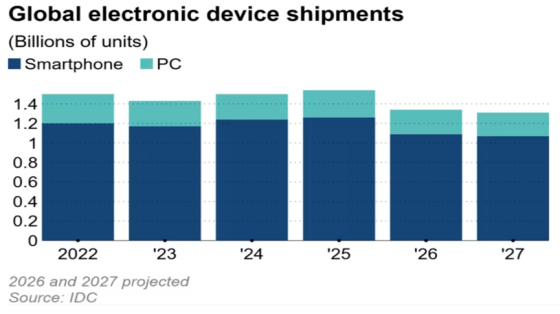
According to IDC's forecast, global smartphone and computer shipments will decrease by 200 million units year-on-year to 1.34 billion units this year. Among them, the shipment volume of smartphones will experience the largest decline in history, a decrease of 14%, and the decline in mid to low end phones is particularly significant because the memory cost of these phones accounts for a higher proportion of the total price of the phone.
Memory shortage also leads to delivery failures of enterprise server products. The shipment to Otsuka Corporation in Japan has been delayed for four months.
Japanese server manufacturer NEC President Takayuki Morita said, "We cannot guarantee a delivery time of more than two months." He suggested that customers place orders as early as possible or use cloud services that do not require independent servers.
Worldwide, the DRAM market is dominated by three companies - Samsung Electronics and SK Hynix from South Korea, and Micron Technology from the United States - which hold a 90% market share.
Due to the surge in demand for artificial intelligence and the rise in commodity prices, the profits of these three companies have significantly increased. It is expected that the net profit of these three companies will increase sevenfold this fiscal year.
But consumer resistance against these companies is growing, and at the end of last month, the United States filed a class action lawsuit accusing these companies of coordinating production cuts since 2022 to push up DRAM prices.
However, due to the decline in DRAM prices, the profits of these companies were also affected during this period.
All three companies have announced investments to increase production to address memory shortages, but even if new facilities take years to start production, tech companies are still willing to invest in artificial intelligence.
Memory manufacturers also hope to avoid overinvestment to prevent prices from falling too low. Many people predict that memory shortages will continue until at least 2027, and high prices will persist in the long term.
According to Hong Kong market research firm Counterpoint Research, the price per gigabit of DRAM will rise from $0.48 in 2025 to $1.96 in 2027. It is expected that the price will fall back to $1.47 in 2028, but it will still remain at a relatively high level.
Related Information




- 1500+ Daily average RFQ Volume

- 20,000.000 Standard Product Unit

- 1800+ Worldwide Manufacturers

- 15,000+ In-stock Warehouse


