 jessica@honch-etech.com
 English

 Item(s)

Power semiconductors are going to rise in price again
According to industry chain news, following Infineon's recent price increase, Taiwanese power semiconductor manufacturers are also considering a new round of price adjustments, possibly starting as early as October this year, to raise prices for non contract products by about 10% to 15%. Supply chain analysis shows that power semiconductors have undergone two rounds of price adjustments since the beginning of this year, with an average price increase of about 15% to 20% in the first half of the year compared to the same period last year. With the continuous expansion of AI data centers, the supply and demand of power devices are further tightening, and the industry chain is brewing a third wave of price increases.
The rise in power semiconductor prices this time cannot be simply understood as a supply and demand change brought about by the traditional cyclical recovery. More importantly, AI is changing the demand structure for power semiconductors: in the past, automotive, industrial, consumer electronics, and other fields were the main markets, but now AI data centers are rapidly becoming a new incremental market, and this market places higher demands on the performance, reliability, and unit value of power devices.
Why does AI have such a significant impact on power semiconductors?
The core reason is simple: the stronger the computing power, the more power it consumes; The higher the chip power, the higher the requirements for power conversion and power management.
With the continuous improvement of computing power by GPUs and AI accelerators, the power consumption of AI server cabinets has gradually evolved from tens of kilowatts and hundreds of kilowatts in the past to hundreds of kilowatts or even megawatts. The 48V/54V power supply architecture used in traditional data centers will face increasingly prominent issues such as current, copper bars, heat dissipation, and conversion losses when facing higher and higher power densities.
Therefore, data centers are exploring higher voltage power supply architectures, with 800VDC becoming an important direction. NVIDIA has publicly promoted the 800VDC architecture and pointed out that the traditional 54V architecture is becoming a bottleneck for the next generation of AI servers. By increasing the high-voltage direct current distribution inside the data center to 800V, the current can be significantly reduced at the same power, thereby reducing copper materials, cable volume, and distribution losses.
This also means that the demand for power semiconductors is undergoing structural changes.
In the past, data center power systems extensively used low-voltage MOSFETs, power ICs, VRMs, and other devices; With the gradual introduction of 800VDC, high-voltage DC-DC, BBU, and centralized power supply architectures, the demand for high-voltage and high-efficiency power devices has significantly increased, and wide bandgap semiconductors such as SiC and GaN have also gained new growth space as a result.
For example, Infineon launched a 24kW SiC battery backup unit reference design for 800V high-voltage AI data centers in June this year, which is directly connected to the 800V DC bus and uses 650V and 1200V SiC technology. This actually indicates that AI data centers are becoming a new application scenario for high-performance power devices such as SiC.
From the perspective of specific devices, AI data centers are not just adding a certain type of power semiconductor, but the demand for the entire power supply chain is increasing.
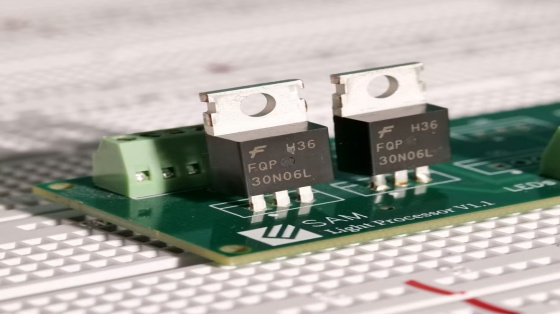
Including MOSFET, power diode, TVS diode IGBT\ Power ICs and various high-voltage power devices are expected to gain incremental demand from the construction of AI data centers.
Especially in the 800VDC architecture, the importance of power conversion efficiency is further enhanced. The AI server itself is already a high-power device. If there is a significant loss of electricity during the multi-level conversion process, it not only means higher electricity bills, but also more heat and higher heat dissipation costs. Therefore, the requirements for power devices in data centers have gradually shifted from "whether they can be used" to "whether the efficiency is high enough and the power density is large enough".
Infineon currently regards SiC and GaN as important technologies for upgrading the power architecture of AI data centers, emphasizing their value in high efficiency, high power density, and peak power processing.
In other words, AI brings not only an increase in the number of power semiconductors, but also an improvement in the ASP and technological content of power semiconductors. **
The second factor driving price increases is that cost pressures are finally beginning to spread downstream.
In addition to the sudden increase in demand, there is also a very practical reason for the price increase of power semiconductors this time: costs have been rising for some time.
Since the beginning of this year, the costs of wafer manufacturing, packaging testing, wire racks, and other raw materials and supply chain links have gradually increased. In the past, due to the incomplete recovery of demand in the terminal market, some costs of power semiconductor manufacturers in the process of competing for orders were not fully transmitted to customers, but were absorbed by the manufacturers themselves.
But with the gradual improvement of demand in AI, automotive, and industrial sectors, the supply and demand relationship in the power semiconductor market is beginning to change.
For manufacturers, as capacity utilization improves and order visibility improves, the necessity of continuing to trade prices for orders decreases significantly. Especially for some high specification power devices, their certification cycle is longer and the cost of replacing suppliers by customers is higher, so manufacturers have stronger bargaining power.
So, the cost pressure accumulated in the past began to gradually spread downstream.
This is also why this round of price increases is different from the "price wars" in the past consumer electronics cycle: it is not simply due to a sudden surge in market demand, but a combination of three factors: demand recovery, product structure upgrading, and cost increase.
In the past, when it came to AI chips, people first thought of GPUs, CPUs, HBMs, advanced packaging, and high-speed interconnects. However, as the scale of AI data centers continues to expand, power is becoming a new bottleneck.
NVIDIA has currently identified 800VDC as an important power supply direction for the next generation of AI factories, and has established ecological cooperation with many power semiconductor and power supply manufacturers such as Infineon, STMicroelectronics, ON Semiconductor, Renesas, Texas Instruments, and Nanomicro Semiconductor.
The industry logic behind this is actually very clear:
The computing power chip determines how fast AI can run, while the power semiconductor determines whether these computing powers can run stably and efficiently.
When the power of AI cabinets increases from 100kW to 600kW, 1MW or even higher, the entire power supply chain needs to be redesigned. From the power grid to the data center, and then to the cabinets, servers GPU, Electricity needs to undergo multi-level conversion, and each link requires the participation of power devices.
Therefore, the demand for power semiconductors brought by AI in the future is not limited to VRMs or PSUs inside servers, but will spread to the entire power chain, including high-voltage direct current distribution AC/DC\DC/DC\BBU\UPS\ Power module and final GPU power supply.
The "computing power revolution" of AI is gradually evolving into a "power revolution", and power semiconductors are the most easily overlooked but increasingly crucial part of this revolution.
From this perspective, this round of power semiconductor price increases may not be just a short-term price adjustment. As AI data centers enter the era of higher power density, the demand structure, technological roadmap, and product value of power devices are changing, and the power semiconductor industry may be entering a new business cycle.
Related Information




- 1500+ Daily average RFQ Volume

- 20,000.000 Standard Product Unit

- 1800+ Worldwide Manufacturers

- 15,000+ In-stock Warehouse


